
In a context of increasing water resource scarcity, the Mediterranean region has always stood out as a climate change hotspot, where water stress directly affects agricultural systems.
In Tunisia, these challenges are particularly significant: pressure on conventional resources, combined with a strong reliance on irrigated agriculture, imposes de repenser en profondeur les modèles de gestion de l’eau.
In this context, reclaimed wastewater reuse (REUSE) emerges as a strategic response. Considered a resource in its own right since the 1990s, it s’inscrit au cœur des politiques nationales visant à sécuriser l’accès à l’eau, à renforcer la résilience des systèmes agricoles et à accompagner l’adaptation au changement climatique.
REUSE: A Systemic Response to a Structural Challenge
In Tunisia, REUSE s’inscrit pleinement dans les stratégies nationales de mobilisation des ressources en eau non conventionnelles, aux côtés du dessalement.
More than a strictly technical solution, it involves a global transformation of water and agricultural systems, encompassing a complete chain d’actors and processes:
- water volume production and availability d’eau
- treatment technologies
- management and distribution
- agricultural practices and sectors
- social acceptability and markets
However, several challenges persist because its deployment relies on a central condition: moving from d’une approche technique à une approche systémique, intégrant gouvernance, usages, risques et dynamiques territoriales, pour garantir une qualité d’eau compatible avec les usages agricoles, lever les freins liés à l’acceptabilité par les consommateurs, adapter les infrastructures (stockage, pompage, distribution) et coordonner des acteurs issus de secteurs distincts (eau, agriculture, santé).
The main challenge today is no longer just producing compliant water, but managing risks throughout the value chain, in an integrated, multi-stakeholder approach.
REUSE: A Foundational Initiative for COSTEA from the Outset

Since 2018, COSTEA s’est engagé sur les enjeux de REUSE en Tunisie, faisant progressivement de cette thématique un axe structurant de ses travaux. Here’s a look at the main stages of this involvement:
International Exploratory Phase
- Inter-country workshops (notably in Lyon)
- Structuring d’une première communauté d’acteurs autour de la REUSE
In-depth National Diagnosis
- Analysis of regulatory and governance frameworks
- Inter-stakeholder coordination: appointment of a SCP (Société Canal de Provence) coordinator, an ONAS (Office National de l’Assainissement) expert, and a consultant specializing in participatory facilitation
- Regulatory and governance benchmark
Territorial Work
- Case studies on two study areas in Tunisia (Souhil in Nabeul and El Hajeb in Sfax) across two types of systems
- Large-scale peri-urban systems
- Decentralized rural systems
- Workshop organization
Production and Capitalization
- Study reports
- Restitution workshop
- Publications of good practice references (Bolivia and Senegal)
- Position paper
As a member state of the Steering Committee (COPIL), the country plays an active role in l’orientation des travaux du réseau, car son positionnement repose sur deux dimensions clés:
- a strong political priority given to REUSE
- a role as a “laboratory country”, capable of producing concrete and operational feedback d’expérience concrets et opérationnels et d’ancrer les travaux du COSTEA dans des réalités terrain
From this perspective, the country appears as a major innovation ground d’innovation majeur, dont les enseignements alimentent une réflexion à l’échelle internationale.
What the Field Confirms: Five Key Lessons
COSTEA’s work, consolidated by Tunisian and international feedback d’expérience tunisiens et internationaux, mettent en évidence plusieurs leviers essentiels pour une opérationnalisation réussie de la REUSE:
- Consider REUSE as an integrated system
→ Au-delà du traitement, c’est l’ensemble de la chaîne de valeur qui doit être structuré - Adapt treatment levels to agricultural uses
→ adapt treatment levels to authorized agricultural uses - Structure regulatory and governance frameworks
→ Clarify roles and strengthen intersectoral coordination - Integrate social acceptability issues
→ Condition clé pour le déploiement à grande échelle - Position REUSE as a climate adaptation lever
→ Sécurisation de l’irrigation, réduction de la pression sur les nappes et barrages
Training at the Heart of Operationalization: The Multi-Barrier Approach
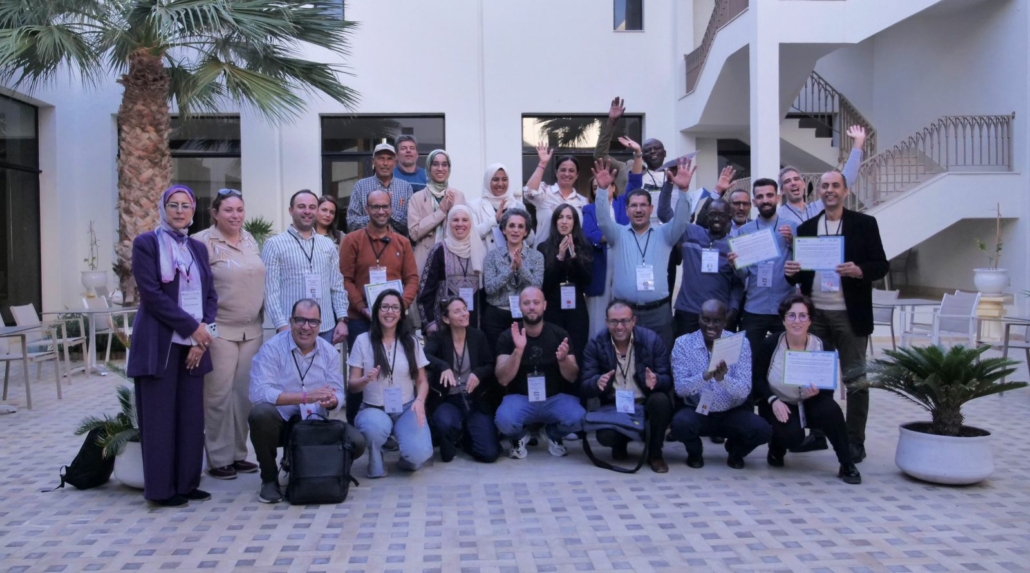
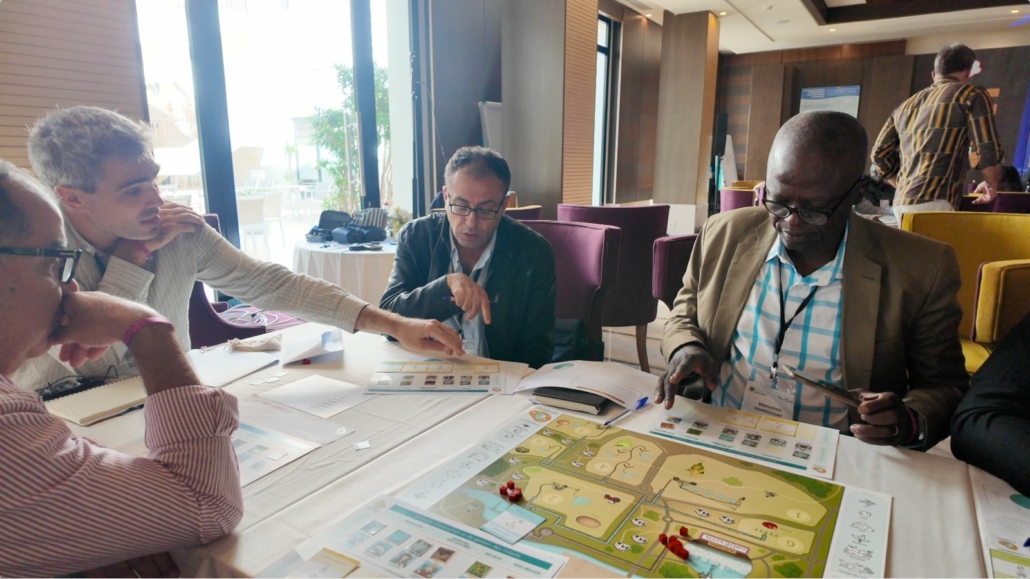
In continuation of this work, COSTEA organized a training session in Tunisia last January dedicated to l’approche dite “multi-barrières”, visant à sécuriser la REUSE sur le plan sanitaire.
Using an innovative pedagogical approach, the training s’est appuyée sur des visites de terrain sur des sites pilotes, et sur un jeu sérieux, l’outil AMBRE, simulant des scénarios de gestion des risques et réunissait des acteurs divers : décideurs publics, représentants du secteur agricole et formateurs
Unlike a top-down approach, this operational and systemic co-construction process fosters ownership, as it allows each stakeholder to contribute to defining solutions.
Participants were thus able to:
- Understand health and environmental risks
- Identify exposure pathways d’exposition
- Develop adapted risk management plans
The video produced on this occasion documents this experience and highlights the complexity of health issues related to REUSE and l’importance d’une approche intégrée et multi-acteurs.
It concretely illustrates COSTEA’s positioning: connecting knowledge production, training, and public action to accelerate l’opérationnalisation et montre la capacité des dispositifs de formation à transformer les pratiques.
Through its work in Tunisia, the COSTEA think tank confirms that REUSE constitutes a strategic lever for the future of irrigation, as it will ultimately secure water resources sustainably, support the agroecological transition, and strengthen the resilience of territories in the face of climate change.